A drop in crude oil prices won’t stop the price of manufactured goods rising.
A drop in crude oil prices won’t stop the price of manufactured goods rising. Don’t think that a slight drop in the price of crude, and a truce in the Persian Gulf, will stop a rise in Australian consumer prices. If the missiles stopped tomorrow, and the Strait of Hormuz was opened, there’s still embedded…
A drop in crude oil prices won’t stop the price of manufactured goods rising.
Don’t think that a slight drop in the price of crude, and a truce in the Persian Gulf, will stop a rise in Australian consumer prices. If the missiles stopped tomorrow, and the Strait of Hormuz was opened, there’s still embedded costs that will emerge in consumer prices over the coming months.
The first wave of disruption from the Persian Gulf conflict was in the direct form of fuel prices and actual supply availability.
Base Oil Cost Shock
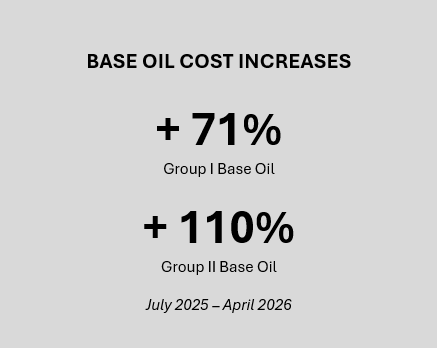
The second wave of the shock, particularly for companies like ours that make lubricant products, has seen crude oil prices lose their direct correlation to the price of manufactures and instead affect the cost of feedstock, if we could even get the quantities we needed. This shock is not about the energy we use to run operations, but the base oils used to make grease, lubricants and hydraulic fluids. Between July 2025 and April 2026, the cost of base oil increased 71% for Group I oil and 110% for Group II. Base oils represent 70-80% of our grease formulation cost.
This secondary, non-fuel effect has seen many participants in the petrochemical industries accepting smaller margins, running down pre-disruption inventory and using their forward-buying arrangements, to try to keep price-rises in check for their customers.
Additives and Hidden Input Costs
But now we have to contend with the third wave of price rises driven by suppliers who make and supply the more complex petrochemical-based chemical additives, such as antioxidants and corrosion inhibitors. Having already compressed their margins over these past four months, they’ve now used up their inventory and the cost of replenishing their feedstocks have escalated greatly. Thus, this next phase, rolling out over July and August, will see the impact of the Middle East crisis amplifying in the business-to-business ecosystem, as these businesses can no longer hold their price increases to minimal levels.
We use many of these additives in our lubricant products, and by the time they reach our factory they have often moved through several freight legs – road, air, sea, distribution hubs and secondary manufacturers. Every step in that chain now carries higher cost.
Australian manufacturers have tried to hold down price increases over these last four months but the tertiary additive companies are now talking about 60 percent increases in the price of some of their stock items. These rising input costs cannot be absorbed or mitigated going forward.
Much of the cascading costs driven by logistics cost and risk, is emerging now because of the lag in product prices compared to fuel. If the Gulf conflict was to end suddenly, and crude oil return to its long-term average, there’d still be stockpiles of inventory sitting with manufacturers, bought when supplies were expensive. Odds are that they will not immediately drop their finished-goods prices just because prices of their inputs are not matching crude oil price movements.
Layering on top of all this, even as we head for ‘peace’ in the Persian Gulf, global oil national stockpiles remain at multi-decade lows, and supply risk is now driven as much by logistics and route security as by production itself. In practical terms, this means availability can appear stable to retail consumers, while behind the curtain execution risk and landed cost continue to rise.
During the four months of the fuel crisis, demand for liquid fuels has not abated in Australia, and during July Australian households and businesses lose some temporary fuel excise relief: the fuel excise relief and Road User Charge relief will each reduce by around 16¢ per litre in July and from 3 August 2026 there will be no relief.
This reinforces upward pressure on logistics and operating costs at a time when procurement complexity is increasing. Two factors illustrates the cascading costs: shipping insurance through the Strait of Hormuz has increased up to 4000 percent since the Gulf conflict started; and the Bunker Adjustment Factor (BAF), a surcharge applied in shipping to offset fluctuations in fuel costs, has increased from US$406 per twenty-foot equivalent container in the second quarter of 2026, to US$696 in Q3.
What This Means for Australian Consumers
So, finished goods prices in this country are not directly correlated to the oil price and we can expect a flurry of rising input costs for Australian industry, which will mean rising consumer prices. It isn’t just manufacturing: look at the agriculture supply chains, which all rely on diesel, long distance transportation and refrigeration (another petroleum-based element). In this sector we should expect to see continued consumer price rises in the second half of the year for staples such as dairy, fruit, veggies, meat and seafood.
There’s no easy fix. Australian manufacturers and their supply chains depend heavily on the petrochemical system, and it is global. Australia has a growing population which means sustained demand for all the things that rely on petrochemical and all of the supply chains and manufacturing stages that underpin it.
We clearly need to move off petrochemical dependence, but until that time we need stable supplies of oil. The future may include renewables, plant-based alternatives and emerging fields such as synthetic biology, which we are already exploring in the grease sector. These changes are coming but their high cost and lack of scalability mean we have to have a plan for this economy. If that means strategic reserves of liquid fuels, opening up oil fields and bringing refineries back to Australia until their alternatives are in place, then they must be considered.
In the meantime, Australian consumers should remember that the low prices we enjoy because we source from large-scale global supply chains, sometimes means prices spike because the supply chains have been disrupted. A global system of manufacturing has not been proved a failure because of the Gulf – it has shown us the price of participation.
Julie Harrison is CEO and Director of Harrison Manufacturing Company